Computation and Picture Books

This is a sample chapter from Picture Book Math an eBook by Carol Otis Hurst and Rebecca Otis (More Information at http://www.carolhurst.com/products/pbmcd.html)
Current research seems to show that solid computation skills come, not so much from repeated drills of methods taught by the teacher, but from the students' ability to create their own methods of computation. This creates a deeper understanding of the process of computation itself. Flexibility and the ability to recognize more than one way of completing the task actually creates a stronger math sense and stronger skill in manipulating numbers.
In this chapter on computation, we are also including estimation because it is so closely intertwined with computation. Estimation comes into play as part of the computation process. We estimate what the computation will provide and we use that estimation to check the accuracy of the computation.
This computation ability develops when students are encouraged to work together to solve problems, when a wide range of approaches to a calculation are solicited by the teacher, and when students are not penalized for doing these things in unconventional ways.
When the focus is on estimating the answer, developing a method for solving a computation and on describing that process to others, students are forced to think about what they did and why they did it, rather than concentrating on getting the right answer. Students still want to get that correct answer, of course, but they need to think about the process involved.
The chapters on measurement, money, data gathering and analyzing, and proportion all contain activities which relate to computation.

Developmental Stages
In PreK the groundwork for later computation includes free exploration of materials communicating attributes and classification.
On the kindergarten level groundwork for later computation ability includes developing a strong number sense. In particular the ability to arrange a certain number of objects in various subgroups helps to build computation skills. Kindergartners are able to see that numbers can be composed of other numbers.
First grade students begin combining and separating groups of objects for addition and subtraction. Addition and subtraction facts can be searched for patterns. Students learn to describe the process they used in adding and subtracting and to listen to the processes described by others.
At the second grade level, adding and subtracting abilities extend to larger numbers and more complex methods of computing. The focus is on flexibility of methods. Multiplication and division processes develop as students continue to manipulate numbers.
Second and third graders can begin to estimate the answer to a given problem before attempting to solve it and can evaluate their answers in terms of its being logical.
Third graders can model basic multiplication and division facts with concrete objects or pictures. They understand and can verbalize the relationships between addition and multiplication and between subtraction and division. They can write an equation to match a story problem. They can partition problems in order to solve them more easily.
Computation Activities
Grades 1-2
Often a book with numerous characters can be used to estimate how many more characters it would take to make ten, or one hundred or thousand.
Grades 1-2
Many books introduce particular foods that the class can prepare. The recipe you use is a fund of computational material. How large is one serving? How many servings do we need? Must the recipe be doubled, tripled or multiplied by another number? They can rewrite the recipe using the required amounts.
Gr 1 - 3
Look for instances in picture books of other models of subtraction such as comparing to find the difference, determining subsets, and finding a missing amount.
Grade 2
Using a meal from a story, find out its nutritional value. Estimate serving size and look up the nutritional content. Find out the recommended daily allowance for that nutrient and determine how many servings the characters would have to eat in order to meet the regulations.
Look at the activities in Data Gathering & Analyzing (in the ebook Picture Book Math, Numeration, page 37 and Measurement page 67) to find more activities that naturally include computations.
Picture Books for Computation
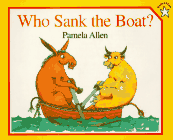
Allen, Pamela. Who Sank the Boat? (Putnam, 1996 ISBN 069811373X)
Five friends: a donkey, a cow, a sheep, a pig, and a mouse, all decide to go for
a boat ride. A question is repeated and answered after each animal gets into
the boat. More Information.
Find out the average weight of each of the five animals. First estimate and then figure out the amount of weight in the boat it took to sink it. Does the order in which they entered the boat make any difference?
Anno, Mitsumasa. Annoís Mysterious Multiplying Jar. (Putnam, 1999
ISBN 0698117530)
We start with a beautiful jar. Inside it is a sea. In the sea is an island. On
each island are two countries. In each country . . . We go on to the original
jar standing in the cupboards. How many jars in all? 10!, or ten factorial. The
nice thing is that Anno then shows how those jars multiplied by using dots on
the page. More Information.
Make up a different story using the pattern in this book.
Make a number sentence for each page of the book.
Anno, Mitsumasa. Annoís Magic Seeds. (Putnam, 1999 ISBN 0698116186)
A wizard gives Jack two seeds and tells him to eat one and bury the other.
Jack does so and the buried seed produces a plant that bears two more seeds.
Jack repeats this process for several years until he decides to bury both
seeds. Readers are challenged with a series of questions throughout the book.
Answer the questions in the book and discuss your conclusions with others before going on in the story. Explain how you arrived at your answers.
Baylor, Byrd. The Table Where Rich People Sit. Illustrated by Peter
Parnall (Aladdin, 1998 ISBN 0689820089)
A young girl narrates a story about how, at her insistence, her family
gathers around their homemade table and talks about their money. The
discussion soon turns into one about values. Soon a list is made in which they
assign monetary value to a series of items and experiences they treasure. More information.
Compute the exact amounts mentioned in the book. Then look at the final amount the girl computes. Make a list of similar items and assign values to them to equal the amount she gets.
Blundell, Tony. Beware of Boys. (HarperTrophy, 1996 ISBN
0688147399)
A small boy wanders into the woods and is captured by a hungry wolf. The
boy suggests a series of recipes that the wolf might use to cook him. In doing
so, the boy gets the better of the wolf. The recipes involve a great many
measurements. More Information.
Theoretically the recipe the boy gives the wolf is for one serving. If your entire class were to share the recipe, what calculations must you make?
Duke, Kate. One Guinea Pig Is Not Enough. (Puffin, 2001 ISBN
014056814X)
Unlike most of the trade books listed in this book, this one was created
specifically for a math program. However its plot is strong and clever. This is
better than the usual counting book as guinea pigs cavort about the pages
increasing and decreasing.
Extend the book. Create a total of thirty or forty guinea pigs.
Duke, Kate. Twenty Is Too Many. (Dutton, 2000 ISBN 052420266)
Like the book listed above by the same author, this one was also deliberately
and successfully designed for use in the math program. Twenty guinea pigs
are presented in various combinations and the equations are carefully placed
as the numerals are incorporated into the illustrations. The guinea pigs
appear on a teetering boat in the middle of the sea. One by one they leave the
boat by various comic means.
Start with forty guinea pigs.
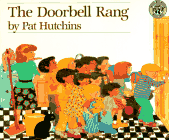
Hutchins, Pat. The Doorbell Rang. (HarperTrophy, 1989 ISBN
0688092349)
Ma has made a dozen cookies for her two children to share, and she is now
trying to clean the kitchen floor. The phrase ìno one makes cookies like
Grandmaî is repeated throughout the book as more and more children arrive
to share the cookies. More Information.
Make number sentences to show your calculations at each stage of the
book.
Increase the number of cookies or the number of children and make
new calculations.
Find recipes for chocolate chip cookies and compare them. Decide
which recipe to follow and increase the amounts in the recipe to make
one cookie for each member of the class.
Johnson, D. B. Henry Hikes to Fitchburg. (Houghton, 2000 ISBN
0395968674)
A bear named Henry makes a bet that he will get to Fitchburg before his
friend does. While his friend does chores to earn enough money for a train
ticket, Henry takes a leisurely stroll through the countryside. Thoreau is the
model for Henry and nineteenth century New England provides the setting
for this romp. More Information.
Figure out the amount of money Henryís friend earns. Estimate the
number of hours he worked and figure out how much he must have
received per hour.
Working at todayís minimum wage, how much money would Henryís
friend have?
Lasky, Kathy. The Librarian Who Measured the Earth. Illustrated by
Kevin Hawkes (Little, 1994 ISBN 0316515264)
This is a work of nonfiction about the life and work of Eratosthenes. He grew
up in Ancient Greece and became a researcher and writer. He produced a
comprehensive geography of the known world and calculated the
circumference of the earth to within 200 miles of todayís figure.
Merriam, Eve. 12 Ways to Get to 11. Illustrated by Bernie Karlin (Aladdin, 1996 ISBN 0689808925)
This inventive counting book starts with numbers one to twelve in numerals
and words and the missing number is 11. We then start investigating
combinations of numbers and things that add up to eleven. Merriamís verse
is delightful.
Pinczes, Elinor. One Hundred Hungry Ants. Illustrated by Bonnie
MacKain (Houghton, 1999 ISBN 0395971233)
The ants head out to a picnic where they plan to get plenty of yummies for
their empty tummies. Because they are, at first, marching single file, the
going seems slow. They are, however, having a good time singing and
laughing as they go. Then one ant decides that they will get there faster if
they change formation and they do so, at his direction, time and time again.
When they finally arrive at the picnic, thereís no food left.
Change the number of ants marching to the picnic and rearrange their formation as many times as in the book.
Pinczes, Elinor. A Remainder of One. Illustrated by Bonnie MacKain
(Houghton, 2002 ISBN 0618250778)
Here we have a regiment of twenty-five beetles on parade. Their queen likes
things tidy and notices that, when they march in twos, there is one bug
bringing up the rear. That lone bug, Joe, dislikes being a remainder and
keeps reorganizing the squadron to eliminate the problem.
Change the number of beetles to another odd number and solve the problem. Tell others your solution without telling them the original number and see if they can figure out what it was.
Rathmann, Peggy. Ten Minutes Till Bedtime. (Puffin, 2004 ISBN
0142400246)
Without looking up from his newspaper, Father announces that itís ìten
minutes till bedtime.î His son and pet hamster see what Father does not.
Outside the window, a large hamster family is approaching the house. The
hamsters board a trolley and head inside. Their house has been publicized on
the web as available for a ì10 Minute Bedtime Tour.î As Father continues his
countdown behind the newspaper, the boy and the hamster tourists use all
sorts of devices to get through each step of the getting ready for bed process.
Calculate the amount of time each step takes.
Scieszka, Jon. Math Curse. Illustrated by Lane Smith (Viking, 1995 ISBN
0670861944)
This is a delightful romp through math and life. Told by her math teacher
that math is everywhere, our narrator proceeds to find math in everything
she touches or thinks about.
How many of the math questions expressed in the book can be given a
definite answer? How would you go about answering them?
Seuss, Dr. The 500 Hats of Bartholomew Cubbins. (Random, 1989 ISBN
039484484X)
Bartholomew Cubbins treasures his inherited but very plain hat with just
one feather. On his way to market, Bartholomew is commanded to take off
his hat for the king. He does so only to find that another hat has appeared on
his head. We know from the title that there are going to be 500 hats and
there are, but not before Barholomew gets into a lot of trouble with the king.
Several times in the story a specific number of hats is stated. Figure
out how many hats Bartholomew must have taken off since the last
stated number.
White, Linda. Too Many Pumpkins. Illustrated by Megan Lloyd (Holiday,
1997 ISBN 0823413209)
A woman hates pumpkins because she had to live on pumpkins when she was
a child. One day a pumpkin rolls off a passing truck and smashes in her yard.
She buries the debris so that she wonít have to look at it. The bumper crop of
pumpkins benefits everyone.
Find some recipes using pumpkin and prepare them. Which ones are most successful? How many times did you have to multiply the recipe to give everyone a taste?
New Books since this article was written
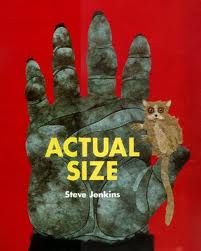 Actual Size by Steve Jenkins. (2004, Houghton. ISBN 0618375945. Order Info.) Nonfiction Picture Book. 28 pages. Gr PreK-3.
This outstanding nonfiction title is another of many wonderful books by Steve Jenkins. His torn paper illustrations created with handmade papers are exquisite and very engaging. In this title animals or parts of animals are shown life size. The eye of a giant squid fills a page and, believe it or not, is beautifully rendered with textured papers. Read More.
Use the life size illustrations in this book to take measurements and add them, find the differences, convert to other units and other computation exercises.
This is a sample chapter from Picture Book Math an eBook by Carol Otis Hurst and Rebecca Otis (More Information at http://www.carolhurst.com/products/pbmcd.html)
Advertisement:
Advertisement:
Advertisement:

