US History, Colonial America 1600-1776

This article by Carol Hurst and Rebecca Otis first appeared in our April 96 newletter.
For more ideas on Colonial America and children's literature check out our book In Times Past.
For our theme this time we have chosen Colonial America. It is often a part of the curriculum, integrates well with literature, and can be approached in an inventive manner. We have listed below some possible discussions, activities and works of literary merit. All of which are intended to be offered as choices to the learner rather than as assignments or lists of things to do. Keep in mind the focus should be on the enjoyment of good books and the excitement of new discoveries.
Discussion Starters
Setting the Stage.
Before beginning classroom or individual work with the Colonial period it is important to set the stage of the time preceding the colonization of what was to become the United States.
When did the native peoples immigrate to this area? What cultural development and changes had taken place before this time period?
How did Columbus's voyage affect future colonization by Spain and England?
This is a good point at which to learn about the Spanish colonization of Latin America that preceded English colonization of the Eastern Seaboard and the Spanish colonization of the US Southwest.
The shape of the Thirteen Colonies.
Looking at a map of the Thirteen Colonies, brainstorm reasons for the various shapes. Follow up with research on how the borders were actually determined.
Native American Conflict.
What was the price paid by whites and natives in this bloody conflict?
Literary discussion.
Looking at a particular piece of historical fiction for this time period: how would you describe the book in general? Is it descriptive, plot driven, or a character study?
Use excerpts from the book to observe how the writer set the time and how the writer included historical events and people in the text.
Discuss the theme or point of view of a particular book. What is the authors point? Are they just trying to illuminate a period? Are they trying to show there are no villains here? Are they illustrating our commonalty with people of the past, or are they trying to illuminate some prejudice and ignorance in the past?
Research Starters:
Native American Population.
Research the groups in different areas and find out as much as you can about their population and its distribution.
Religious Viewpoints.
What were the different religious viewpoints of various segments of the colonial population and the Native American population? How did these effect the development of the Thirteen Colonies and the Southwest Colonies?
Treatment of the Native Americans.
Research the various relationships between groups of settlers and the local Native Americans.
French Colonization.
Compare the French colonization in Canada with the English colonization of the Thirteen Colonies.
Colonial Life.
Research such aspects of colonial life as dwellings, commerce, foods, government, and dependence on England, France or Spain.
Activities:
Immigrants.
Make a chart of groups of European immigrants during this time period. Show dates, main reasons for immigrating, main location in colonies, financial status, and type of community they developed.
Map of Book Titles.
Using a bulletin board size map of the thirteen colonies place book titles for different historical fiction available at the geographic location of it's setting.
Where would you put the colonies.
Locate a relief map of the eastern seaboard with no boundaries. Given that there were thirteen colonies and knowing no borders, where would you put them if you were the king of England? Take into account such things as access to coastline, navigable rivers, and raw materials.
Choose one of the areas you have mapped out as a fantasy colony. Determine what areas might have been forested, where fish would be plentiful, and the possibility of other natural resources. Which of these could your colony have offered to England for trade? What would the advantages of that colony's shape and location be? What would the disadvantages be?
Given what you now know and today's sensitivities what agreements would you try to work out with the Native Americans in that area. Find out the concerns of the Native American peoples living in that area at the time. Now look at a map of the real thirteen colonies. How do they compare to your choices in boundaries? Do research to see if you can find out some of the reasons for the differences.
Agreements between the colonies.
Staying with your imaginary colonies, what would these colonies trade with each other? What kind of money system would they need? What kind of agreements would they need between the different colonies in order to get along together smoothly?
Now research the Articles of Confederation to discover which of your concerns were addressed. Which additional concerns does the Articles of Confederation address?
Leaders.
Research the leaders of white settlers and Native Americans during this period. Make charts comparing their situations, their goals, the obstacles and their accomplishments.
Make a chart showing the relative social and financial class of various leaders. Compare this information to characters in books of the same time period.
Southwest Colonies.
Create a time line paralleling the development of the Thirteen Colonies and the Southwest colonies of the US.
Conflicting Needs.
Make a chart such as the following
 ___________________________________________________________________________
|What England| What the   | What the  |  What the  |  What the  | What the  |
|  Wanted    |English     |Native     | African    |  French    | Spanish   |
|            | Settlers   | Americans | Americans  | Settlers   | Settlers  |
|            | Wanted     |  Wanted   | Wanted     |  Wanted    |  Wanted   |
|____________|____________|___________|____________|____________|___________|
|            |            |           |            |            |           |
|            |            |           |            |            |           |
|            |            |           |            |            |           |
|____________|____________|___________|____________|____________|___________|
Place Names.
Look at a current atlas of the thirteen states and/or the southwest colonies. Which town names came from English, Spanish, or French towns? Which came from Native American languages? What other names (such as rivers, lakes, and states) came from the various languages?
Characters in historical fiction and nonfiction.
Make a chart of the characters you encounter showing where they lived, why they (or their ancestors) came, obstacles encountered and success.
Make a time line of characters from a few colonial period historical fiction/nonfiction books. Add to the time line important historical events.
Discuss any ways in which the events might have affected the characters.
Draw a silhouette of a character with adjectives inside the silhouette which describe that character. Around the outside provide documentation from the book to support each adjective.
Make a time line of characters from a few colonial period historical fiction/nonfiction books. Add to the time line important historical events.
Discuss any ways in which the events might have affected the characters.
Books set in the Colonial Period:
Picture Books:
*Costabel, Eva Deutsch. The Jews of New Amsterdam. (Atheneum, 1988. ISBN 0-689-31351-9. Order Online) Grades 2+.
New York, 1650's.
This simplified text gives an overview of the Jews' effect on the Dutch
colony of New Amsterdam.
*Forest, Heather. The Baker's Dozen. Illustrated by Susan Graber .
(Harcourt, 1992 ISBN 0 15 200412 2. Paperback.) Grades 1+.
The custom of the baker's dozen is shown here to have started in a town in
colonial America.
*Lobel, Arnold. On the Day Peter Stuyvesant Sailed into Town. (Harper, 1971. ISBN 0-06-443144-4.) Grades 1+.
New York, 1647.
This text follows the development of New Amsterdam during Stuyvesant's
efforts to organize the town. Author Info.
*Locker, Thomas. The Land of Gray Wolf. (Dial, 1990. ISBN 0-8037-0936-6. Order Online) Grades 2+.
The destruction of the wilderness viewed through the eyes of a Native
American child.
*McGovern, Ann. If You Sailed on the Mayflower in 1620. Illustrated by Anna DiVito. (Scholastic, 1991. ISBN 0-590-45161-8 Order Online). Grades 2+.
Plymouth, Massachusetts, 1620.
A question and answer format book about life during the Mayflower voyage.
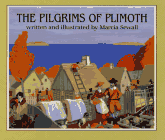
***Sewell, Marcia. Pilgrims of Plimouth. (Macmillan, 1986. ISBN 0-689-31250-4. Order Online) Nonfiction. Grades 2+.
Plymouth, Massachusetts, 1620's.
With more historical accuracy than many picture books, Sewell tells of the
daily life of the people commonly referred to as Pilgrims.
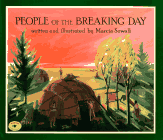
***Sewall, Marcia. People of the Breaking Day. (Atheneum, 1990. ISBN 0-689-31407-8 Order Online). Nonfiction. Grades 2+.
Plymouth, Massachusetts. 1620's.
This is daily life from the point of view of the Native Americans living in
the area where the Pilgrims settled.
***Sewall, Marcia. Thunder From the Clear Sky. (Atheneum, 1995. ISBN 0-689-31775-1 Order Online). Nonfiction. Grades 2+.
Plymouth, Massachusetts. 1620's.
With alternating viewpoints of the Wampanoag and Pilgrims this book tells
the story of their interactions.
Novels
**Avi. Night Journeys. (Morrow, 1979 ISBN 0-688-05298-3. Paperback.) 160 pages. Grades 4+.
Pennsylvania and New Jersey, 1768.
Peter York's guardian, Everett, is a devout Quaker and, in 1768, his care
of Peter seems unbending and unfair. He joins a hunt for some runaway
indentured servants on the Pennsylvania - New Jersey border, only to find
that they have been truly mistreated. Now he must seek help from Everett to
help the children.
*Bulla, Clyde Robert. Charlie's House. (Knopf, 1993 ISBN 0-679-83841-4.) 96 pages. Gr. 3+.
An indentured servant, Charlie Brig comes to America seeking a prosperous
life and finds instead that he is indentured to an impossibly cruel man,
the only escape from whom is to cast his lot with the runaway slaves.
*Bulla, Clyde Robert. A Lion to Guard Us. (HarperCollins, 1981 ISBN
0-690-04097-0. Order Online.) 117 pages. Gr. 3+.
Virginia.
In this accessible, brief novel, we have the story of three children who,
after their mother dies, make their way to Virginia Colony in search of
their father.
**Clapp, Patricia. Constance: A Story of Early Plymouth. (Morrow, 1968 ISBN 0-688-10976-4. Order Online.) 256 pages. Grades 6+.
Plymouth, Massachusetts. 1620's.
This novel gives us an imaginary journal kept by Constance Hopkins from the
time she sails on the Mayflower until her wedding five years later.
Although a work of fiction, the book sticks quite closely to the facts and
gives us a personal look at the day to day life in Plymouth.
*Clapp, Patricia. Witches' Children: A Story of Salem. (Puffin, 1987. ISBN 084466572X. Order Online.) Grades 4+.
Salem, Massachusetts. Late 1600's.
The first person narrative of a girl swept up in the witch hunt hysteria.
*Dillon, Eilis. The Seekers. (Charles Scribner's, 1986. 0-684-18595-4. Order Online.) 136pg. Grade 5+.
Yorkshire, England and Plymouth Colony, 1632.
A teenager travels with the family of his fiancee to Plymouth. The Saints
(the Pilgrims who were in Plymouth for religious reasons) are shown as
hardworking, generous and intolerant. After learning and experiencing much
the young couple returns to England.
**Field, Rachel. Calico Bush. (Dell, 1931. ISBN 0-440-40368-5. Order Online.) Grades 5+.
Massachusetts and Maine, 1743.
This 1931 Newbery Award winner stands the test of time. The story of a
French orphan indentured to an English family, this book gives us an
intimate portrait of the interactions and prejudices between the two groups
of settlers and the English family's conflict with local Native Americans.
*Fleischman, Paul. Saturnalia. (HarperCollins, 1990 ISBN 0060219130. Order Online.) 128 pages. Gr. 5+.
Boston, 1681.
William's Narragansett village has been attacked and he seems to be its
sole survivor. Apprenticed to a printer in Boston in 1681, he walks the
night streets hoping to find some trace of his family.
*Fritz, Jean. The Cabin Faced West. (Putnam, 1958. ISBN 0399232230. Order Online.). Grades 3+.
Pennsylvania, early 1700's.
The experiences of a ten year old girl adjusting to life in the woods
without other children to play with. Based on the Jean Fritz's
grandmother's experiences.
**Fritz, Jean. Early Thunder. (Putnam, 1967. ISBN 0140322590. Order Online.) Grades 5+.
Massachusetts, 1770's.
This novel offers a more balanced view than most of the period immediately
preceding the Revolutionary War.
**Keehn, Sally M. I Am Regina. (Philomel, 1990. ISBN 0-399-21797-5. Order Online.) Grade 6+.
Pennsylvania, mid 1700's.
The story of a white girl captured by Native Americans at the age of 10 and
then returned at the age of 18 and her adjustments to the two cultures.
*Koller, Jackie French. The Primrose Way. (Harcourt. 1992 ISBN
0-15-256745-3. Order Online.) 275 pages. Gr. 5+.
Agawam, Massachusetts, 1633.
The clash of cultures between the Pawtucket Indians and the new settlers is
the focus for this novel. Rebekah, the daughter of a missionary, befriends
a young Native American girl and is accused of siding against her own
family.
**Monjo, F. N. The House on Stink Alley. (Dell, 1977. ISBN 0-440-43376-2. Order Online.). Grade 2+.
Holland, early 1600's.
Based on primary sources this book tells of the Pilgrims' years in Holland
prior to their sailing to the New World.
***Petry, Ann. Tituba of Salem Village. (Harper Trophy. 1991 ISBN
0-064-40403-X. Order Online.) 254 pages. Grades 5+.
Salem, Massachusetts. 1600's.
This slightly fictionalized account of the Salem witchcraft trials shows
how suspicion is cast on Tituba, not only because she can tell fortunes,
but because she is black and friendless. The girls who accuse her and
others are portrayed variously as foolish, misguided, and self-centered.
Salem, Massachusetts. 1600's.
The book deals with the witchcraft trials through Susanna English who knew from the beginning that the young women who "cried out" against witches were coldly aware of what they were doing. Unable to reveal the secret because of the very real fear that they might cry out against her or her family Susanna struggles with overwhelming guilt as one by one the nonconformists in that Puritan community were led to the gallows.
*Rinaldi, Ann. The Fifth of March. (Harcourt, 1993 ISBN 0 15 200343 6. Order Online.) Grades 5+.
Boston, Massachusetts, 1768.
Rachel Marsh is the indentured servant for John and Abigail Adams. The
skirmishes with the British soldiers have started but Rachel falls in love
with a British soldier brought to trial after the Boston Massacre.
***Speare, Elizabeth George. Witch of Blackbird Pond. (Dell, 1978. ISBN 0 440 99577 9. Order Online.) 256pg. 6+.
Connecticut, 1688.
Kit Tyler spent the first sixteen years of her life in the Barbados where
rules were less restrictive. At Blackbird Pond, the only place where Kit
feels free, she meets and befriends Hannah, a Quaker whom villagers suspect
of witchcraft.
Nonfiction:
*Ayer, Eleanor H. The Anasazi. (Walker, 1993 ISBN 0-8027-8184-5. Order Online.) 112 pages. Grades 5+.
This book, which traces the rise and fall of the Anasazi society in what is
now the southwestern U.S., gives us a source of comparison between
dwellings and societies in this and other areas of the country.
**Bowen, Gary. Stranded at Plimoth Plantation 1626. (HarperCollins, 1994. ISBN 0 06 022542 4. Order Online.) 82pg. Grades 3+.
Plymouth, Massachusetts, 1626.
The journal entries of a young indentured
servant are short and successful in showing the character of the boy as
well as depicting the daily life of Plymouth. Much of the superstition,
folk cures and early medicinal treatments are included. The woodcuts are
well done and add an authentic note.
**Bradford, William. Homes in the Wilderness: A Pilgrim's Journal of
Plymouth Plantation in 1620. (Shoe String, 1988 ISBN 0208022694. Order Online.) 75
pages. Grades 4+.
Plymouth, Massachusetts, 1620.
Based on Bradford's own journal, this small book tells of the Mayflower
journey, and the events of the first years in Plimoth Colony. Included are
entries from the actual journal.
Fradin, Dennis. The Connecticut Colony (ISBN 0-516-00393-3. Order Online).
The Georgia Colony (ISBN 0-516-00392-5. Order Online.).
The Maryland Colony (ISBN 0-516-00394-1. Order Online.).
The Massachusetts Colony (0-516-00386-0. Order Online.).
The New Hampshire Colony (0-516-00388-7. Order Online.).
The New Jersey Colony (ISBN 051600395X. Order Online.).
The New York Colony (ISBN 0-516-00389-5. Order Online.).
The North Carolina Colony (ISBN 0-516-00396-8. Order Online.).
The Pennsylvania Colony (ISBN 0-516-00390-9. Order Online.).
The Rhode Island Colony (ISBN 0-516-00391-7. Order Online.).
The Virginia Colony (ISBN 0-516-00387-9. Order Online.).
The Delaware Colony (ISBN 0-516-00398-4. Order Online.).
The South Carolina Colony (ISBN 051600397-6. Order Online.).
The entire series is published by Children's Press, 1990. Grade 2+.
This series provides generous amounts of otherwise hard to find information
about the development of the individual colonies.
**Fritz, Jean. The Double Life of Pocahontas. (Putnam, 1983. ISBN
0-399-21016-4. Order Online.). Grades 3+.
The true story of the Native American princess Pocahontas and her life
between two cultures, beautifully told by Fritz's sure hand.
*Fritz, Jean. George Washington's Mother. (Putnam, 1992 ISBN
0448403846. Order Online.) 48 pages. Grades 2+.
All right, so she wasn't one of the movers and shakers of history; her son
surely was and this brief, very accessible biography gives us a glimpse of
the times and the sharp-tongued mother of the father of the country.
*Fritz, Jean. Who's That Stepping on Plymouth Rock? (Putnam, 1975 ISBN 0-698-20325-9. Order Online.) 48 pages. Grades 2.
Plymouth, Massachusetts. 1620.
The rock is surely a famous one but Fritz manages to debunk many of the
"truths'" that have surrounded it as she follows its history to the present
day.
**Fritz, Jean. Will You Sign Here, John Hancock? (Coward, 1982. ISBN 0-698-20308-9. Order Online.) Grades 3+.
Massachusetts, 1737-1793.
An accessible biography of the famous signer of the Declaration of Independence.
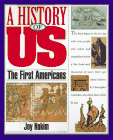
***Hakim, Joy. The First Americans (Oxford, 1992 ISBN 0 19 507746 6. Order Online.)
Making Thirteen Colonies (Oxford, 1992 ISBN 0-19-507748-2. Order Online.)
From Colonies to Country (Oxford, 1993 ISBN 0-19-507750-4. Order Online.)
Grades 3+.
Hakim has brought a fresh voice to U. S. History for young readers. These
three volumes of her History of US series cover the time period under
discussion. Her style is breezy. Her facts accurate and the sidebars and
captions make the books as good for browsing as they are for careful
reading. Most of latter, probably, will be done by teachers seeking
background information.
*Hooks, William H. The Legend of the White Doe. (Simon and Schuster, 1988 ISBN 0-02-744350-7. Order Online.) 44 pages. Grades 4+.
First Hooks gives us the facts, although precious are known, about the
first English child born in America. He then goes on to recount the legend
of her transformation into a white doe who, even today, can sometimes be
glimpsed in the Great Dismal Swamp.
***Marrin, Albert. The Struggle for a Continent: The French and Indian
Wars 1690-1760. (Atheneum , 1987 ISBN 0-689-31313-6. Order Online.) 218 pages. Grades 6+. Challenging reading.
Marrin's detailed, historical account may be more than some young readers
want to tackle, but Marrin has a way of using details to paint broader
pictures and the information here is invaluable to any teacher leading a
study of this time period.
*Quackenbush, Robert. Old Silver Leg Takes Over: A Story of Peter
Stuyvesant. (Prentice-Hall, 1986 ISBN 0-13-633934-4. Order Online.) 35 pages. Grades 1+.
New York, 1640's.
Quackenbush's typically irreverent eye is turned to the governor of New
Amsterdam when he took over in 1647. The city's filth and slovenly behavior
appalled him and he set about cleaning it up.
*Roop, Connie & Peter. Pilgrim Voices: Our First Year in the New World. (Walker, 1995 ISBN 0 8027 8314 7. Order Online.) Grades 3+.
Plymouth, Massachusetts, 1620.
Using selections from William Bradford's "Of Plymouth Plantation" and
"Mourt's Relation", the Roops trace the history of the Pilgrims from their
departure from Holland until the arrival of the second ship, The Fortune,
in 1621.
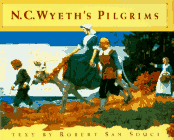
*San Souci, Robert. N. C. Wyeth's Pilgrims. (Chronicle, 1991 ISBN
0-87701-806-5. Order Online.) 40 pages. Gr. 3+.
The illustrations come from a mural painted by N. C. Wyeth for the New York
Metropolitan Life Building in 1940. The text is San Souci's and he uses it
to expand and narrate the paintings.
*Sherrow, Victoria. Huskings, Quiltings and Barn Raisings: Work-Play
Parties in Early America. (Walker, 1992 ISBN 0 8027 8188 8.) Grade 3+.
The work was undeniable hard but could be made lighter with many hands and
so work became a large part of the social life of the early settlers.
Sherrow recounts the joy as well as the labor. (More on Quilting.)
*St. George, Judith. Mason and Dixon's Line of Fire. (Putnam, 1991 ISBN 0-399-22240-5. Order Online.) 128 pages. Gr. 4+.
We think of this line in connection with the Civil War, but the story of
how it came to be brings the conflict between settlers and Native Americans
into sharp contrast.
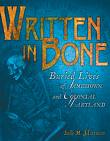 ***Walker, Sally M. Written in Bone: Buried Lives of Jamestown and Colonial Maryland (Carolrhoda, 2009 ISBN 9780822571353. Order Online.) 144 pages. Gr 6+.
This outstanding nonfiction book brings the wildly popular science of forensics into the historical discovery of 17th century graves in and around Jamestown, Virginia. The on-the-scene author follows the scientists as they work to uncover mysteries about the bodies of a Captain, an African slave girl, an upper class woman and more. Great photographs, fascinating content and brilliantly written. Read More.
***Zeinert, Karen. Salem Witch Trials. (Franklin Watts, 1989. ISBN 053110673X. Order Online.) Grades 4+.
Salem, Massachusetts, 1692.
This book explores the causes of the witch hunt hysteria in ways that help
us make sense of what would otherwise seem ridiculous. Highly recommended
for children and adults.
Related Areas of Carol Hurst's Children's Literature Site
US History
(URL: http://www.carolhurst.com/subjects/ushistory/ushistory.html )
Our US History Section has articles, historical fiction and activities for integrating US History with children's literature.
In Times Past
(URL: http://www.carolhurst.com/products/intimes.html )
Here you'll find information on our professional book In Times Past where you'll find a lot more information similar to this Featured Subject section for teachers integrating US History with children's literature.
The Time of the Pilgrims: 1600-1700. Featured Subject with activities, related books and links.
Internet links for the Colonial Period:
Caution: If you follow the links below you will be leaving Carol Hurst's Children's Literature Site and will need to use your "back" button to return.
Archiving Early America
(URL: http://earlyamerica.com/ )
This site focuses on 18th century Colonial US History using newspapers,
maps and writings from the period. You can view the original documents
right on your screen. An amazing resource for primary source information
and for making the past come alive. Everything from feature articles on
historical events to the classified sections.
Table of Contents for The World of Benjamin Franklin
(URL: http://sln.fi.edu/TOC.franklin.html )
The World of Benjamin Franklin Exhibit from The Franklin Institute Science
Museum (URL: http://sln.fi.edu/ ) provides a generous sampling of well
organized information on the life of Benjamin Franklin.
Indians of North America, The Native American Experience, 1600 to 1750
(URL: http://www.csulb.edu/gc/libarts/am-indian/nae/1600-1750.html )
This collection of illustrations from Facts on File publisher contributed
by Professor Troy Johnson from the California State University, gives
portraits of such famous people as Pocahontas along with drawings and
paintings of scenes from this time period.
United States History Maps
(URL: http://www.lib.utexas.edu/Libs/PCL/Map_collection/histus.html)
This is a great resource. The maps are worth the wait to download. For this
time period you can get maps such as: Native American groups in the East or
West, Exploration and Settlement Before 1675. This site is provided by the
University of Texas at Austin.
Selections from The African-American Mosaic: A Library of Congress Resource Guide for the Study of Black History and Culture
(URL: http://lcweb.loc.gov/exhibits/African.American/intro.html )
There is not a great deal available concerning the African American
experience of this time period. But, this site in particular has a great
deal of information on the period immediately following which can give us
insight into the 1600-1776 period.
Advertisement:
Advertisement:
Advertisement:

