Little Blue and Little Yellow

by Leo Lionni.  Picture Book. 48 pages. Grades PreK-8.
Find this book: Amazon
Review
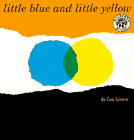
Leo Lionni devised this story while on a train trip with his grandchildren. Usually he drew stories for them as he told the stories but this time he had no drawing materials. Tearing circles of color from a magazine, he improvised this story and later wrote it down for the rest of us.
Illustrated with splotches of color, the story has several layers of meaning from the simple story of friendship through the exploration of color to the feelings of racial prejudice. We are shown Little Blue as a ragged circle of blue on the white page. Later we meet his mother and father, his many friends, but especially Little Yellow who lives across the street with Mama Yellow and Papa Yellow. Using only these simple shapes, Lionni shows the children at school and at play. Then, when Little Blue and Little Yellow are separated for a bit only to find each other at last, they are so joyful that they hug each other and turn green. As a single green shape, they play and then go, first to Little Blue’s house and then to Little Yellow’s only to be rejected and unrecognized. They cry little blue and yellow tears until they are all tears and then, punningly, they "pull themselves together and go home" as separate shapes again.
Follow up activities can include color mixing with paint, of course, but it’s even more effective done with circles of color on the overhead projector.
(Continued Below)
Advertisement:
(Continued Below)
Advertisement:
Related Books
 Grades K - 5
Seven Blind Mice by Ed Young. Picture Book. 48 pages.
Find this book: Local Bookstore, Amazon, B&N
In this startlingly illustrated version of "The Blind Man and the Elephant," seven blind mice go, one by one, to identify a large object. Each perceives one part of it and pronounces it to be something. It is only the white mouse who sees the elephant. Grades PreK - 9
The Artist Who Painted a Blue Horse by Eric Carle. Picture Book. 32 pages.
Find this book: Local Bookstore, Amazon
In his first book in four years Eric Carle honors one of the great artists who inspired his singular style. The title gives a hint as to the identity of the boy narrator of the story. However, the story itself is a simple, almost wordless, tale of a child painting--a blue horse, a red alligator, a pink rabbit, a yellow cow and more. Our narrator closes with, "I am a good artist." It is only after this that Carle includes a reproduction of "Blue Horse" by Franz Marc along with a short biography. Read More.
Advertisement:

