Geology through Kids' Books

Let's take geology for our theme this quarter. We can highlight some wonderful nonfiction, some fine picture books and, with just a slight stretch, some very good novels. Since the line between geology and geography gets blurry, we can include some good books on that subject and, because of fossils, we can step into paleontology as well. Nobody does science better than Seymour Simon and he's done so many books that fit in here that our theme almost becomes an author study of that wonderful man. Check out his website at simon@seymoursimon.com then, grab your rock hammer and a library card and get started.
As with any theme, it's important to allow the kids as many choices as possible as often as possible. We want committed learners here actively pursuing information. Whenever a subtopic or subject is broached that interests someone, encourage him or her to go with it, taking it in directions that are of personal interest. Keep your own mind on the goal - you're not trying to make geologists of them all. You're exposing them to some general knowledge and showing them how to find further information, organize what they have learned and figure out an interesting way to present it to others.
We can start with Diane Siebert and Wendell Minor's compelling and beautiful hymn to the mountains, Sierra (HarperCollins, 1991 ISBN 0064434419. Paperback.). Minor's illustrations are so fascinating, his perspectives so constantly changing, that people usually need a couple of times through the book just to concentrate on the pictures. When you get to the prose, however, you find that it's not prose at all but poetry, beautifully done and full of information. It's the mountain itself that speaks to us and it tells us about the moving plates of earth that created it and its sister peaks. A theme on geology can't do better than to start with such beauty. You can use it anywhere from second grade up. Put the book in a prominent place and tell the kids it's the book of the day. Suggest that they take the time to look it through, enjoying the illustrations, before you read it aloud.
Then pull out the same team's Mojave (HarperCollins, 1992 ISBN 0064432831 Paperback. Library Binding) and Heartland (HarperCollins, 1989 ISBN 0690047304). Here too it's the land that speaks to us in beautiful poetry with Minor's unique perspectives. Let the kids read these to each other, but be sure they have ample time for rehearsal first. The pages make natural breaks to switch readers and most kids from late second grade up can handle it if they get time to practice. Since the subjects here are the desert and the plain respectively, we've been in the mountains, plain and desert and we haven't left Siebert and Minor yet.
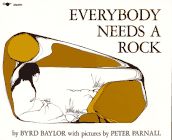
It's time to jump into the real world. Introduce the picture book by Byrd Baylor and Peter Parnall, Everybody Needs a Rock (Simon, 1974 ISBN 0689710518. Paperback). In this simple and elegant picture book, the author gives ten rules for choosing a personal rock. In the process, we explore rocks through all the senses. Start the rock collection. Put out the guide and identification books. Post the following adapted Moh's hardness scale and let the kids start identifying the rocks and stones.
- Hardness 1. You can scratch it with a fingernail easily
- Hardness 2. You can scratch it with a fingernail but it's hard to do so
- Hardness 3. You can scratch it with a penny
- Hardness 4. You can scratch it with a knife. Limestone is this hardness.
- Hardness 5. You can scratch it with a knife but you have to bear down hard.
- Hardness 6. It will scratch a knife
- Hardness 7. It will scratch glass
- Hardness 8. It will scratch quartz
- Hardness 9. It will scratch topaz
- Hardness 10. Diamond - it will scratch any other rock
The Magic School Bus Inside the Earth by Joanna Cole with illustrations by Bruce Degen (Scholastic, 1987 ISBN 0590407600. Paperback.) is the next book to explore with the kids. The duos usual combination of humor, fiction and nonfiction works as well as ever as Ms Frizzle and her class dig through the earth encountering and identifying the layers of rock they encounter before emerging in the lava of an erupting volcano. Follow that book with The Pebble in My Pocket by Meredith Hooper and Christopher Coady (Viking, 1996 ISBN 0670862592 Hardcover). We view the effects of change over millions of years on the life of a pebble.
Fill the sand and mud tables or make them if you need to. Put out pitchers of water and have the kids take careful note of the geologic changes which result when they pour it over either surface. Tilt the tables and watch those effects as well. Use an electric fan to create wind effects on both surfaces. Encourage the kids to invent their own experiments with wind, water and soil.
Put out pictures of the Grand Canyon and allow children to speculate on the forces that created it - wind, erosion and water. To demonstrate the power of water to change rock formation, soak a piece of sandstone in water overnight. Then place the sandstone in the freezer. In most cases the sandstone will be broken into pieces as the water expands.
Turn back to the books. It's the team of Baylor and Parnall again in If You Are a Hunter of Fossils (Simon, 1980 ISBN 0689707738. Paperback). Here we look to the signs within the rocks of earlier life from trilobytes to seed ferns. The fossils are treated as things of beauty in and of themselves as well as relics of life.
 0688154794
Put out the following books by Seymour Simon: Volcanoes (Mulberry, 1988 ISBN 0688140297. Paperback.), Earthquakes (Mulberry, 1991 ISBN 068814022X. Paperback), Oceans (Morrow, 1990 ISBN 0688094538. Hardcover. Paperback.), Deserts (Morrow, 1990 ISBN 0688074162. Library Binding. Paperback), Icebergs & Glaciers (Morrow, 1987 ISBN 0688061869. Hardcover.), Mountains (Morrow, 1994 ISBN 0688110401. Hardcover. Paperback.), and Storms (Mulberry, 1992 ISBN 0688117082. Paperback). Each of these books uses really spectacular color photographs that grab your attention. The text is within the reach of most second graders yet the information is such that most adults will find something fascinating in these books that they didn't know before. Simon makes comparisons kids can grasp and he has never lost his sense of the wonder of it all. He never oversimplifies or makes unfounded generalizations. Thank you Mr. Simon.
Suggest that the kids look at those books in twos, jotting down anything they come to that interests them. All but the most blase should come up with several statements to display on a board labeled Simon Says and then pursue that topic in another information source in order to add to another part of the bulletin board labeled I Wonder If Mr. Simon Knows. Since you can email him (simon@seymoursimon.com) at his website (http://www.seymoursimon.com), some of the kids may want to discuss it with the man himself.
Simon's Volcano might lead to a sort of companion volume by Kathryn Lasky and her husband, Christopher Knight:
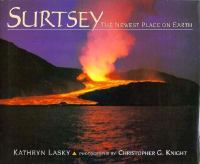 Surtsey: The Newest Place on Earth by Kathryn Lasky. Illustrated by Christopher Knight. (1992, Houghton Mifflin. ISBN 9780618062768. Order Info.) Nonfiction Photographic Essay. 64 pages. Gr 3-8.
This photo essay details the volcanic events which created a new island, rising up from the sea, south of Iceland in 1963. This is a beautiful and well-designed book. Through this book we can imagine what it was like when Hawaii and other volcanic islands first formed.
Joanne Ryder's books usually involves a transformation into a different life form. In Earthdance (Holt, 1996 ISBN 0805026789. Library Binding.), the reader is asked to become the earth itself, spinning in space. In the process we begin to understand the formation of the earth.
Related Areas of Carol Hurst's Children's Literature Site
- Seymour Simon. Featured Author.
- Everybody Needs a Rock by Byrd Baylor. Book Review.
- Deserts through Kids Books. Literature-based Classroom Unit with activities, related books and links for grades PreK-9.
- Weather and Children's Books. Featured Subject with books, activities and links.
- Mud Flat Olympics by James Stevenson. Featured Book with Math activities.
- Letting Swift River Go by Jane Yolen. Featured Book with activities, related books and links.
Related Areas on the Internet
- US Geological Survey's "Ask a Geologist Site" (http://walrus.wr.usgs.gov/ask-a-geologist/) where you can email your question to a Geologist.
- Bob's Rock Shop (http://www.rockhounds.com/) which sounds like a store but is really an online mineral magazine. Check out the pictures.
- Museum of Paleontology (UC Berkeley) (http://www.ucmp.berkeley.edu/) lots of information.
- How to Identify Rocks (http://www.sdnhm.org/kids/minerals/index.html)
Advertisement:
Advertisement:
Advertisement:

